Leading Up to the Crisis
The Cause of the Cuban Missile Crisis can be traced back to the Failed Bay of Pigs Invasion, but the Bay of Pigs Invasion and through that, the crisis, can be traced back even further, to the end of World War 2, and the quest for global economic domination.
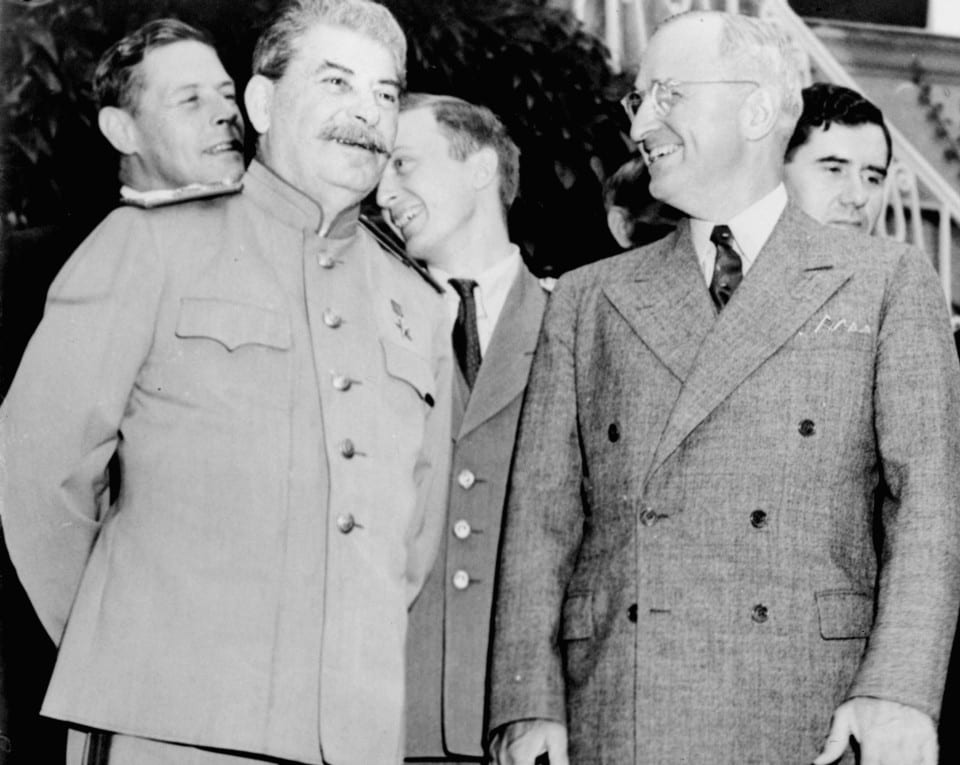
Premier Joseph Stalin, left, and President Harry S. Truman in Berlin on July 24, 1945.
Credit: Associated Press
The world after wW2
During World War 2, the United States and the Soviet Union, were strong allies in the fight against Nazi Germany, but shortly after the war was over, the US and USSR had what you could call a falling out. The Soviet Union effectively controlled all of Eastern Europe and half of Germany, and created what we call the Iron Curtain. It was both a physical and metaphorical wall (depending where in Europe you were) that separated the Soviet Union from the rest of the world. Encyclopedia Britannica says this about the two superpowers at the time: "The Americans and the British feared the permanent Soviet domination of eastern Europe and the threat of Soviet-influenced communist parties coming to power in the democracies of western Europe. The Soviets, on the other hand, were determined to maintain control of eastern Europe in order to safeguard against any possible renewed threat from Germany, and they were intent on spreading communism worldwide, largely for ideological reasons." The difference in views and fear of the "other side" eventually dissolved the relationship it had with the US, and eventually, because of economic and political differences, they launched the Cold War, which was really a period with high tensions between the two countries, and a series of proxy wars.
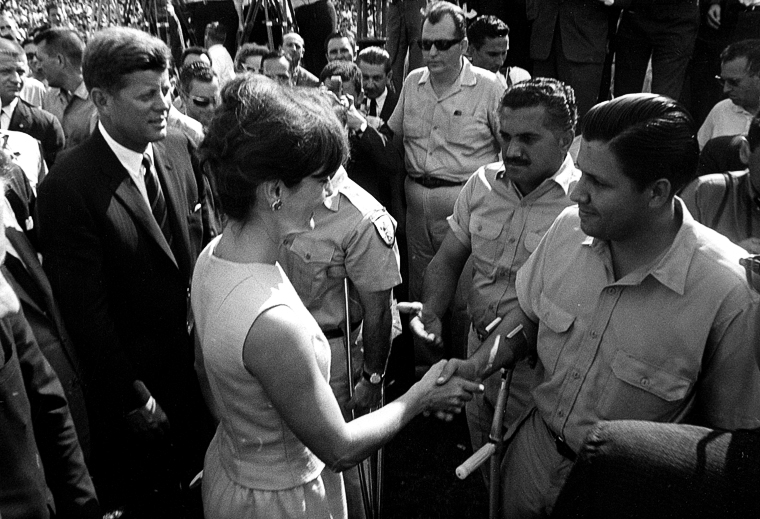
President and Mrs. Kennedy greet members of the 2506 Cuban Invasion Brigade.
Credit: Cecil Stoughton/John F. Kennedy Presidential Library and Museum
The bay of pigs invasion
In the 1950s, the Cuban Revolution occurred. In this revolution, Fidel Castro took over Cuba and converted the democratic capitalist government at the time to a communist one. This lead to Cuba cutting all ties with the United States. Cuba cutting ties with America was not very good for the US economy because all of the American owned businesses in Cuba were shut down. In response, an angered US government planned an invasion into Cuba. The invasion is known as the Bay of Pigs invasion. The invasion ended up failing horribly for the United States, and all ground soldiers were captured as prisoners of war. The John F. Kennedy Presidential Library and Museum says this about the deal made for the prisoners: "Attorney General Robert F. Kennedy made personal pleas for contributions from pharmaceutical companies and baby food manufacturers, and Castro eventually settled on $53 million worth of baby food and medicine in exchange for the prisoners." Even after the failure of the US, Fidel Castro still feared an invasion, so he requested help from the Soviet Union. Instead of sending soldiers or supplies to Cuba, the Soviet Union sent mid range nuclear ballistic missiles. While this could have been because they wanted to help Cuba, the most probable reason is because it gave the USSR the ability to strike any city in the Continental United States. The United States was obviously furious and tensions between the two superpowers shot up to an all time high. From that moment on to when the missiles were removed, the current "dispute" was called the Cuban Missile Crisis.